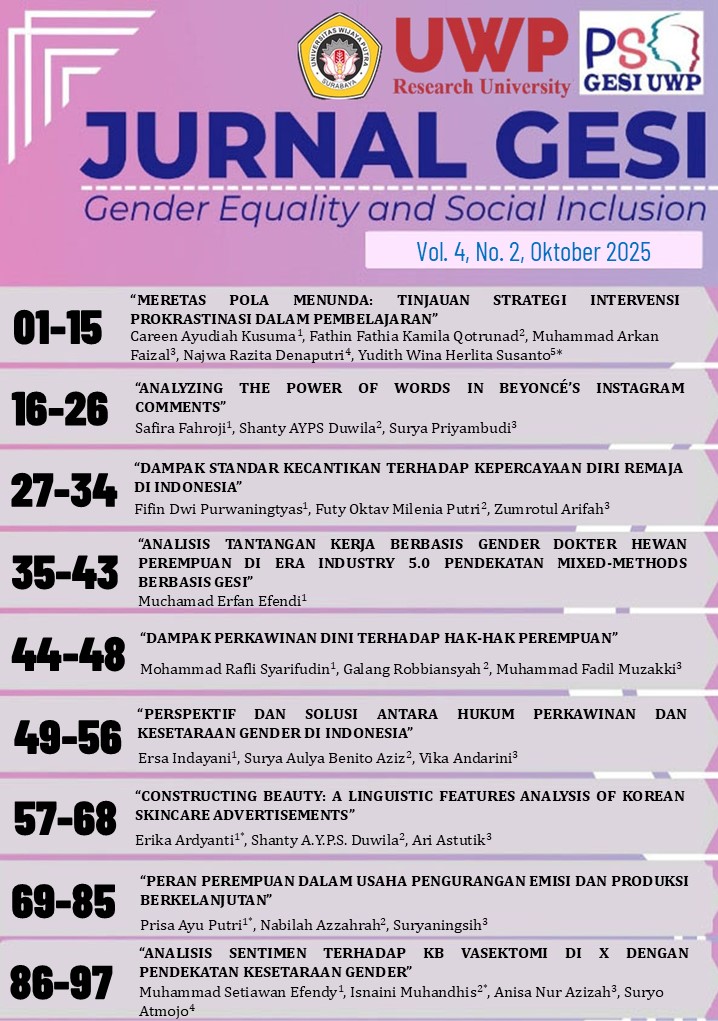
DAMPAK STANDAR KECANTIKAN TERHADAP KEPERCAYAAN DIRI REMAJA DI INDONESIA
indonesia
DOI:
https://doi.org/10.38156/gesi.v4i2.198Keywords:
Standar Kecantikan, Kepercayaan Diri, remaja, Persepsi Diri, MediaAbstract
This study was motivated by the growing influence of beauty standards shaped by the media on the self-confidence of young women in Indonesia. Popular culture and beauty advertisements have constructed the notion that beauty is associated with fair skin, a slim body, and smooth facial features, which affect adolescents’ self-perception. The purpose of this study is to investigate how beauty standards affect the confidence levels of young women. This research employed a descriptive qualitative approach through in-depth interviews with two female adolescents aged 16–17 who have experienced pressure related to appearance. The findings suggest that social media plays a significant role in shaping perceptions of beauty, leading some teenagers to feel less confident if they do not meet certain physical standards. However, some participants can reject such views by realizing that beauty is relative. The study concludes that socially constructed beauty standards can negatively affect self-confidence, highlighting the importance of self-acceptance as the foundation of true beauty.
References
Arikunto, S. (2017). Metodologi Penelitian Suatu Pendekatan Proposal. 2017.
Arini, D. P. (2021). Emerging Adulthood : Pengembangan Teori Erikson Mengenai Teori Psikososial Pada Abad 21. Jurnal Ilmiah Psyche, 15(01). https://doi.org/10.33557/jpsyche.v15i01.1377
Bandura, A. (1997). Self-efficacy: The exercise of control. In Self-efficacy: The exercise of control. W H Freeman/Times Books/ Henry Holt & Co.
Creswell, John W., Poth, C. N. (2018). Qualitative Inquiry and Research Design (International Student Edition): Choosing Among Five Approaches (4th ed). In Qualitative Inquiry and Research Design (International Student Edition): Choosing Among Five Approaches (4th ed) (4th ed).
Djamba, Y. K., & Neuman, W. L. (2002). Social Research Methods: Qualitative and Quantitative Approaches. In Teaching Sociology (Vol. 30, Issue 3). https://doi.org/10.2307/3211488
Fardouly, J., Diedrichs, P. C., Vartanian, L. R., & Halliwell, E. (2015). Social comparisons on social media: the impact of Facebook on young women’s body image concerns and mood. Body Image, 13, 38–45. https://doi.org/10.1016/j.bodyim.2014.12.002
Homan, K. J., & Tylka, T. L. (2014). Appearance-based exercise motivation moderates the relationship between exercise frequency and positive body image. Body Image, 11(2), 101–108. https://doi.org/10.1016/j.bodyim.2014.01.003
Miles, M. B., Huberman, A. M., & Saldaña, J. (2014). Qualitative Data Analysis: A Methods Sourcebook.
Moleong, J. L. (2020). metodologi penelitian kualitatif J lexy Moleong. Jurnal Ilmiah.
Najwa Syalsabilla, Arya Dwi Andika, Putri Wahyuni Sitohang, V. N. M., & Nazwa, Z. (2025). Mitos Kecantikan dan Tubuh Perempuan Dalam Film Tall Girl (2019): Analisis Representasi Dengan Perspektif Naomi Wolf. 2(1), 188–196.
Pamirma, M. Y. E., & Satwika, Y. W. (2022). Hubungan antara paparan media dengan body image pada remaja perempuan. Character: Jurnal Penelitian Psikologi, 9(6), 2–10. https://ejournal.unesa.ac.id/index.php/character/article/view/47316
Perloff, R. M. (2014). Social Media Effects on Young Women’s Body Image Concerns: Theoretical Perspectives and an Agenda for Research. Sex Roles, 71(11), 363–377. https://doi.org/10.1007/s11199-014-0384-6
Safitri, V., & Prabawa, A. F. (2024). Kajian Literatur: Self-Confidence, Self-Concept dan Sikap Tafa’ul. Social, Humanities, and Educational Studies (SHES): Conference Series, 7(3), 1924–1935. https://doi.org/10.20961/shes.v7i3.92348
Santrock, J. W. (2019). Life-span development, 7th ed. In Life-span development, 7th ed.
Sarah Grogan. (2021). Body Image: Understanding Body Dissatisfaction in Men, Women and Children (4th Editio). https://doi.org/https://doi.org/10.4324/9781003100041
Saraswati, L. A. (2016). Seeing beauty, sensing race in transnational Indonesia. Seeing Beauty, Sensing Race in Transnational Indonesia, 1–173.
Sugiyono. (2018). Sugiyono Metode Penelitian Kuantitatif Kualitatif. Metode Penelitian Kuantitatif Kualitatif.
Tiggemann, M., & Slater, A. (2013). NetGirls: the Internet, Facebook, and body image concern in adolescent girls. The International Journal of Eating Disorders, 46(6), 630–633. https://doi.org/10.1002/eat.22141
Downloads
Published
How to Cite
Issue
Section
License
Copyright (c) 2025 Fifin Dwi Purwaningtyas Fifin, Futy Oktav Milenia Putri, Zumrotul Arifah

This work is licensed under a Creative Commons Attribution-NonCommercial 4.0 International License.